
I've spent nearly a decade being involved with the Fair Haven Fire Company, and almost 3 years now as an active Emergency Medical Responder, on the Fair Haven Volunteer First Aid Squad. I also serve as Co-Director of IT for the first aid squad, and it was in this capacity when the line officers of our squad were running into a quality issue when it came to our EMS call documentation.
I don't mean the clinical care was bad, my squad works hard, shows up, and takes care of patients. But when reading through the ePCR narratives we were writing, we kept finding the same problems over and over. Vitals with no context. Scenes described vaguely. Interventions listed but not connected to why we did them.
And the frustrating thing is there was no real feedback loop. We'd run a call, file the report, our line officers would review the documentation, make edits and finalize it. There wasn’t a good way to practice writing narratives and quickly receiving feedback on how to improve. So when looking into a tool, where we could write narratives and receive immediate feedback, especially feedback that referenced our individual squads quality standards, we found nothing. So I spent some weeks building one.
What Backboard EMS Actually Is
Backboard is an EMS training platform. There are a couple different skills you can practice within the app, currently the most developed and main selling point is narrative writing and practice. But the app also is getting Triage Practice, and Protocol Practice. Let me walk through what I built and why each piece exists.
Scenario Practice
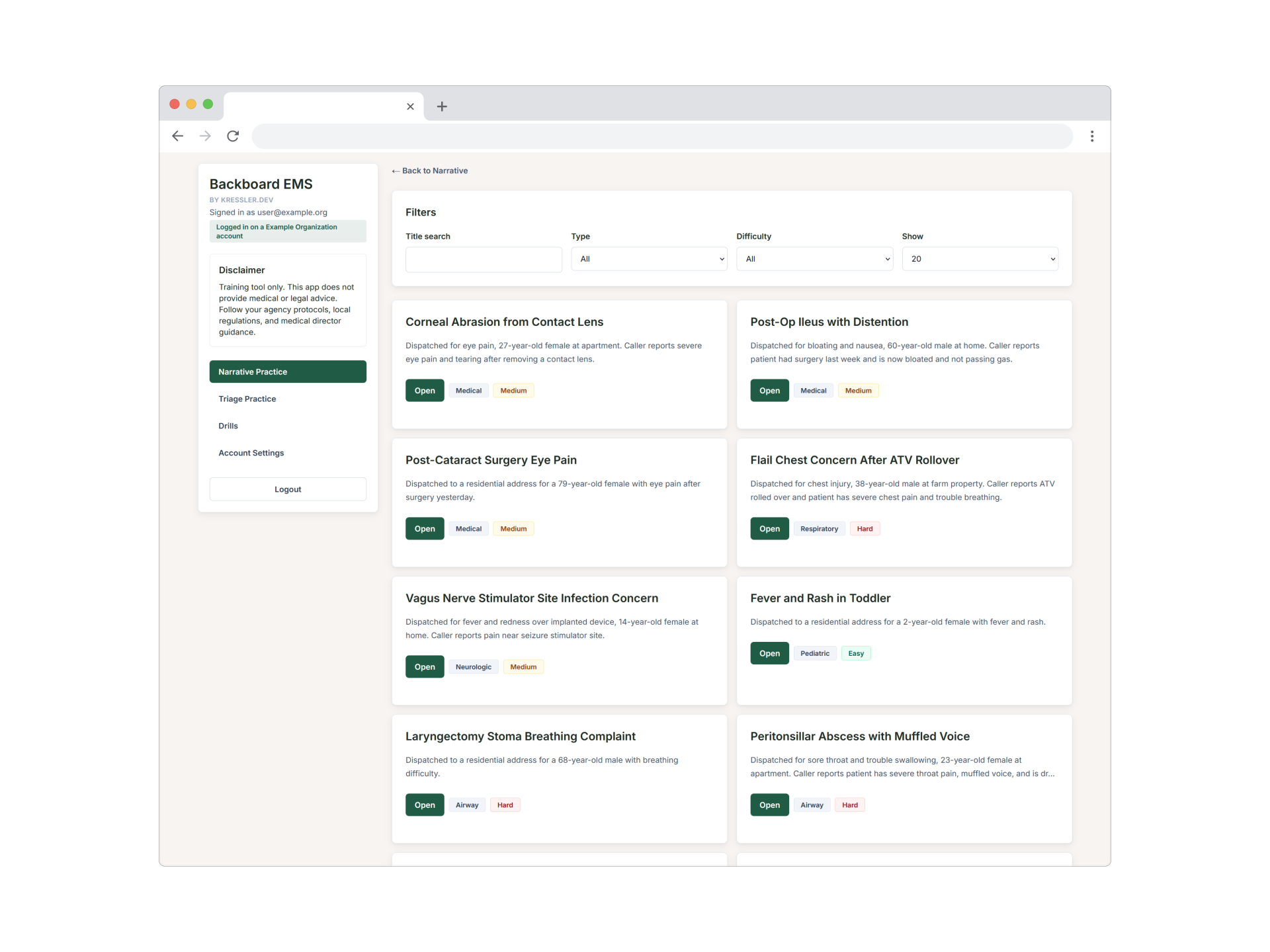
The core feature is a library of realistic EMS scenarios, chest pain at a grocery store, pediatric respiratory distress, MVC with a confused patient, behavioral health calls, overdoses. The kind of calls your people actually run.
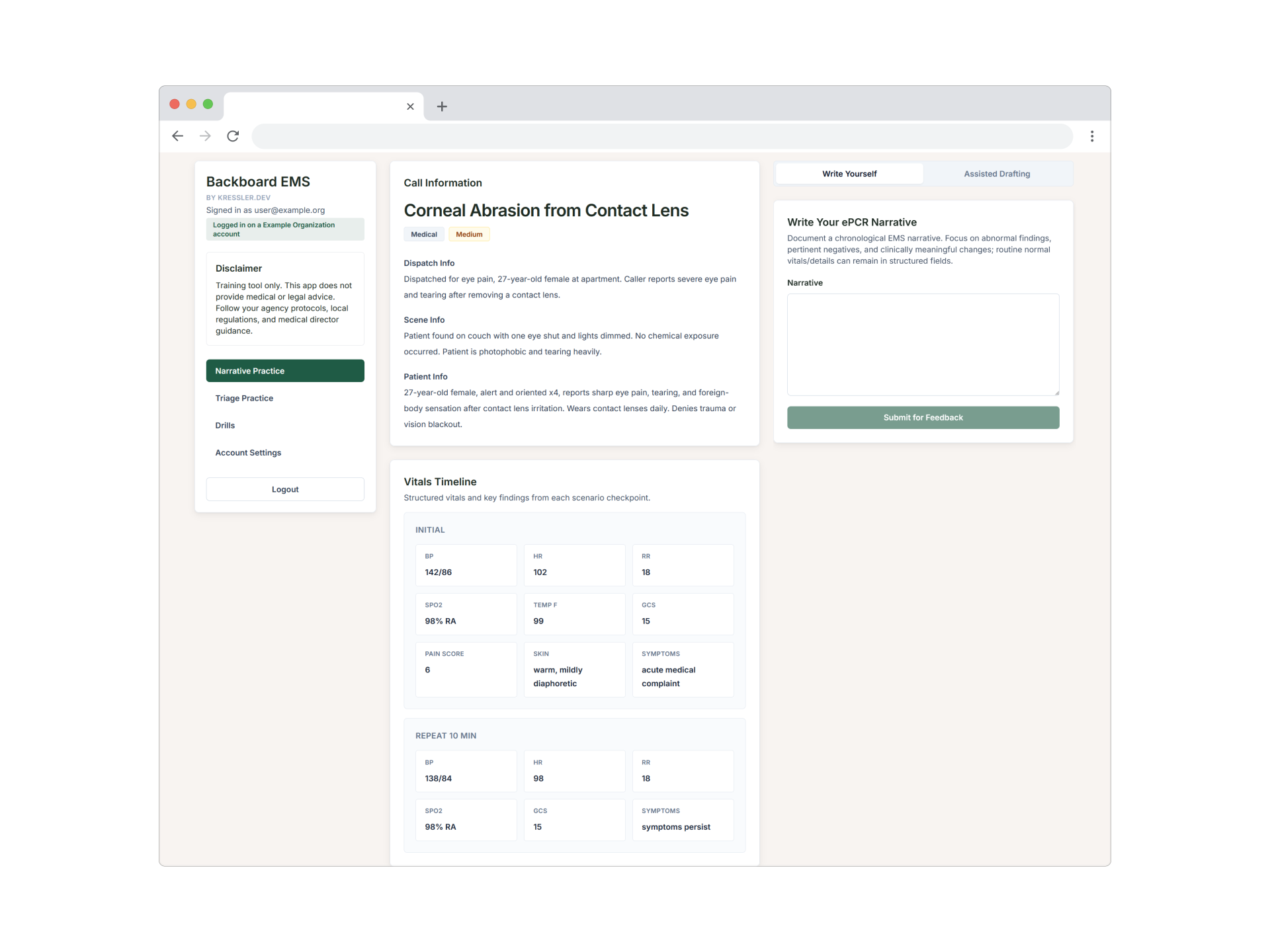
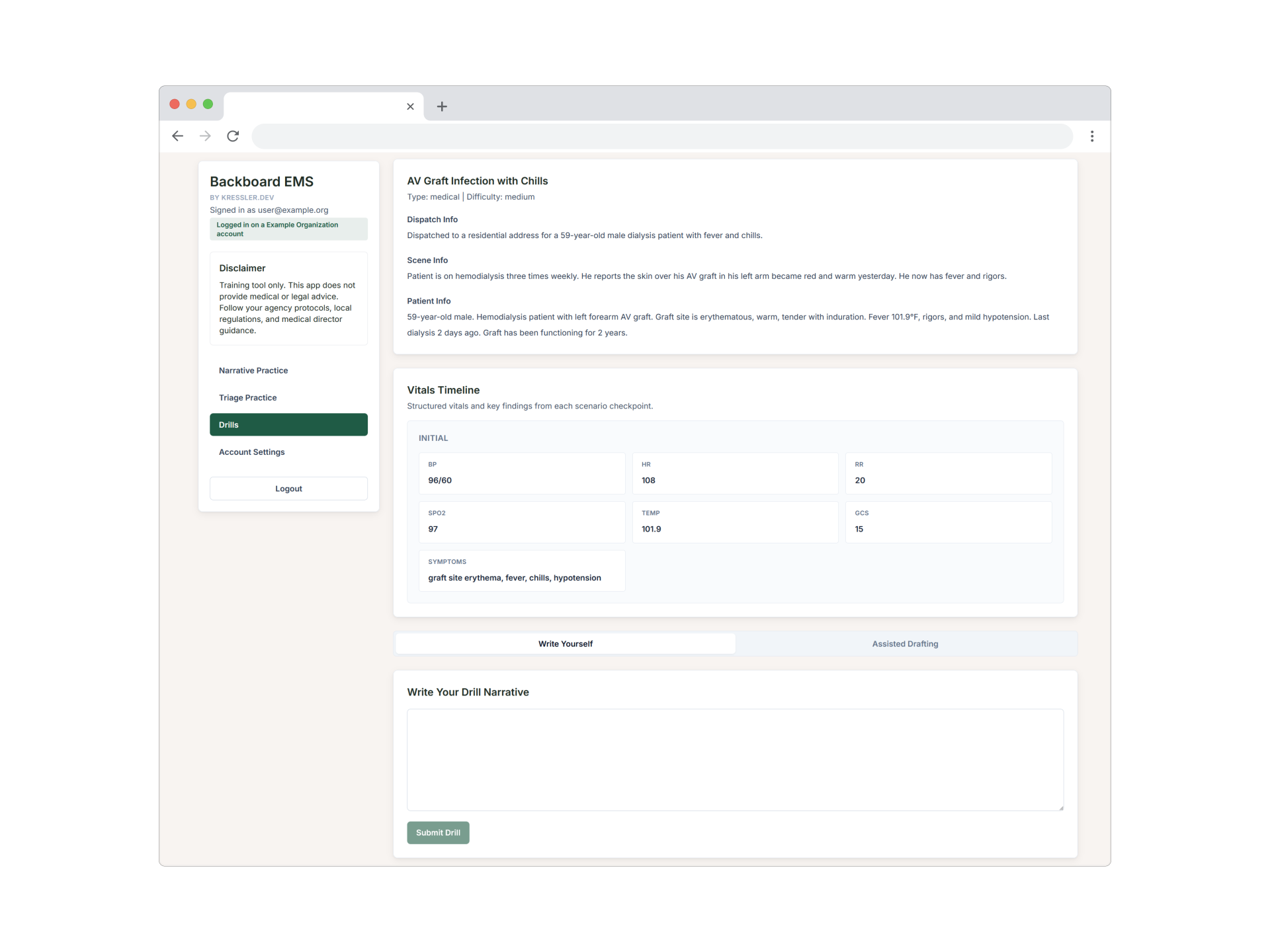
A user opens a scenario, gets the dispatch information, the scene details, how the patient presented, and vitals. Then they write a narrative. Then they ‘submit’ it.
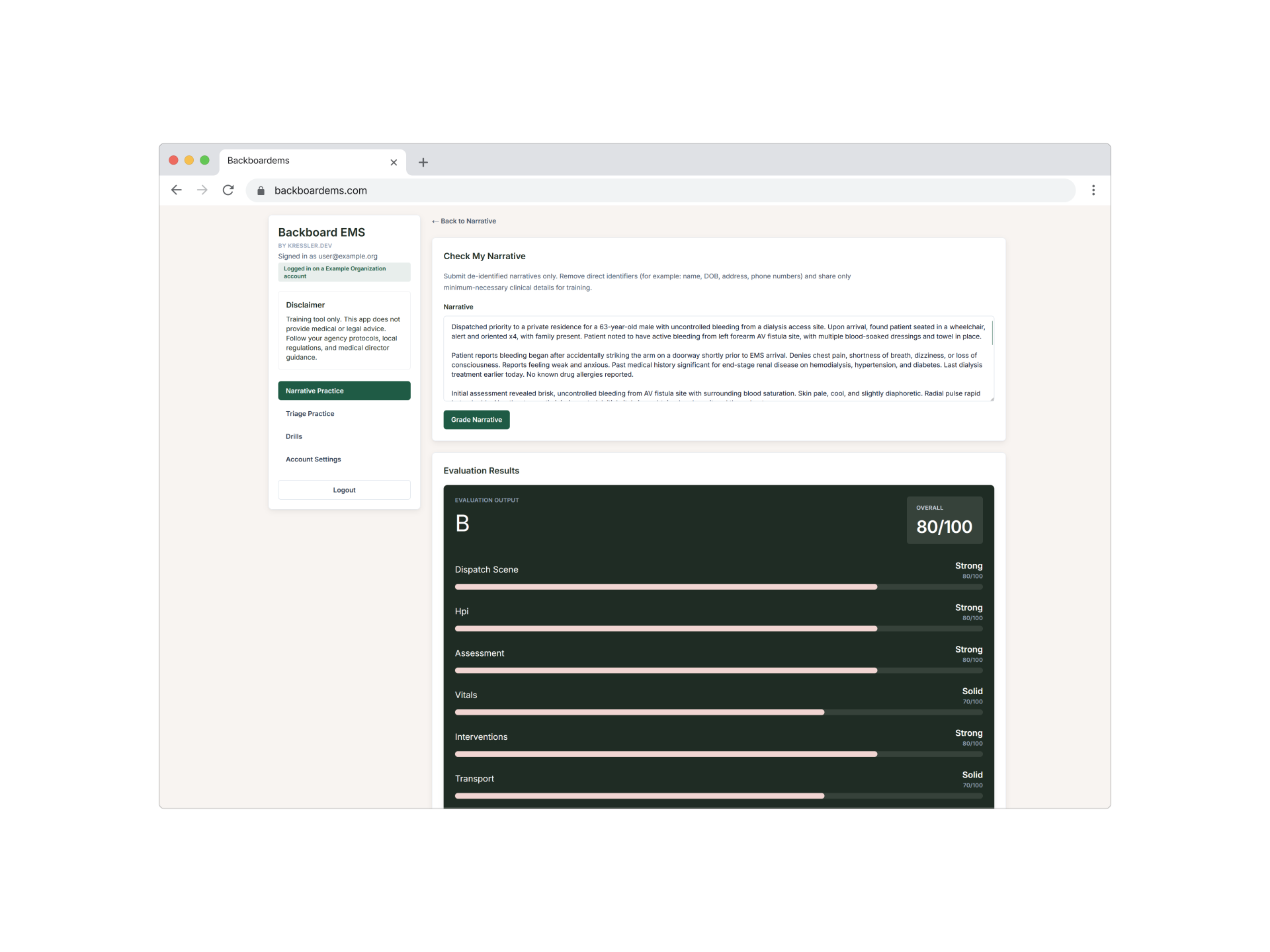
The AI grades the narrative across seven categories: how well they set the scene, how complete the HPI is, whether the assessment makes sense, how vitals are documented, whether interventions are explained and connected to findings, how transport and disposition are described, and overall documentation quality, things like chronological flow, legal defensibility, and whether the narrative actually tells the story of the call. If your organization has specific standards, in your organization admin settings you can add additional parameters for the AI to take into consideration when grading.
Each category gets a score. You get specific feedback on what was strong, what was missing, and suggestions for what to fix. The goal was never to replace a training officer. The goal was to give providers immediate, detailed feedback at scale, the kind of feedback that would take a captain an hour to give for 10 narratives, available in seconds for every narrative.
The Draft Tool
A lot of providers don't struggle because they don't have skills. They struggle because they don't have a structure. They sit down to write and they don't know where to start.
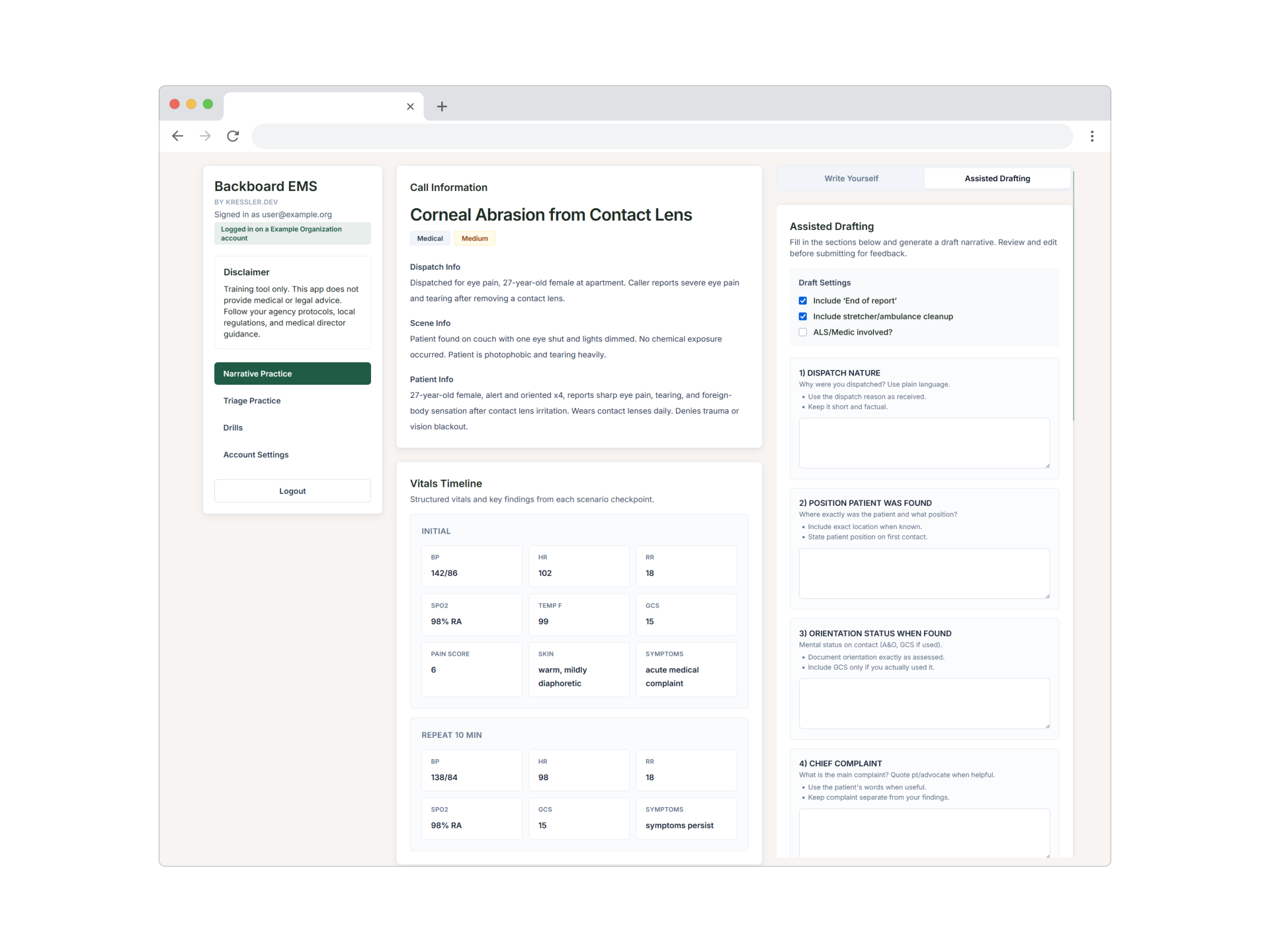
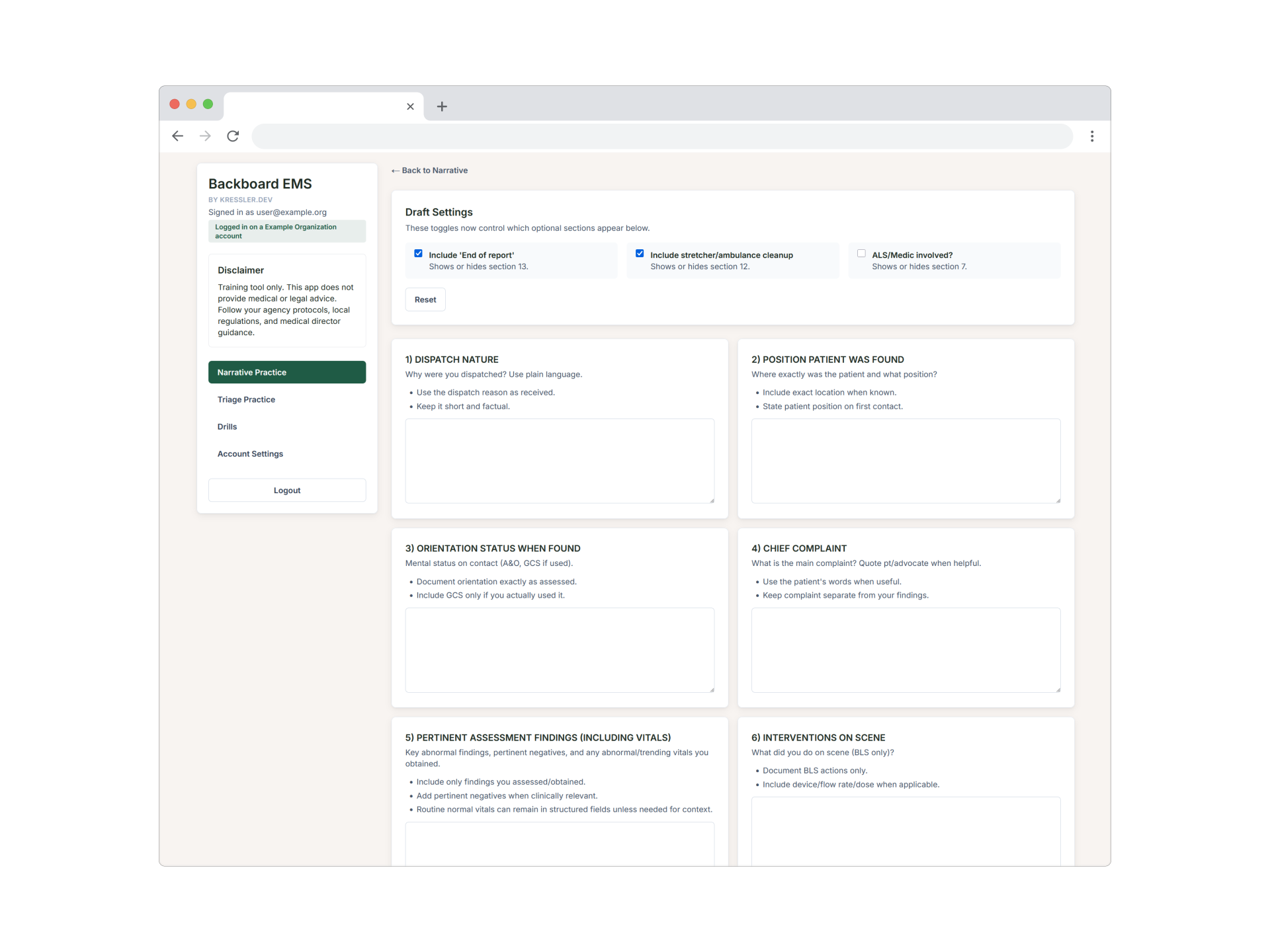
So I built a guided drafting tool that walks through thirteen sections of a good narrative, one at a time. Dispatch. How you found the patient. Mental status. Chief complaint. Assessment findings. Interventions. Transport. You fill in each section with guidance prompts telling you what belongs there. When you're done, you can ask the AI to compose those sections into a coherent, readable narrative.
It's less about AI writing the narrative for you and more about learning what the narrative needs to contain and in what order.
Protocol Trainer
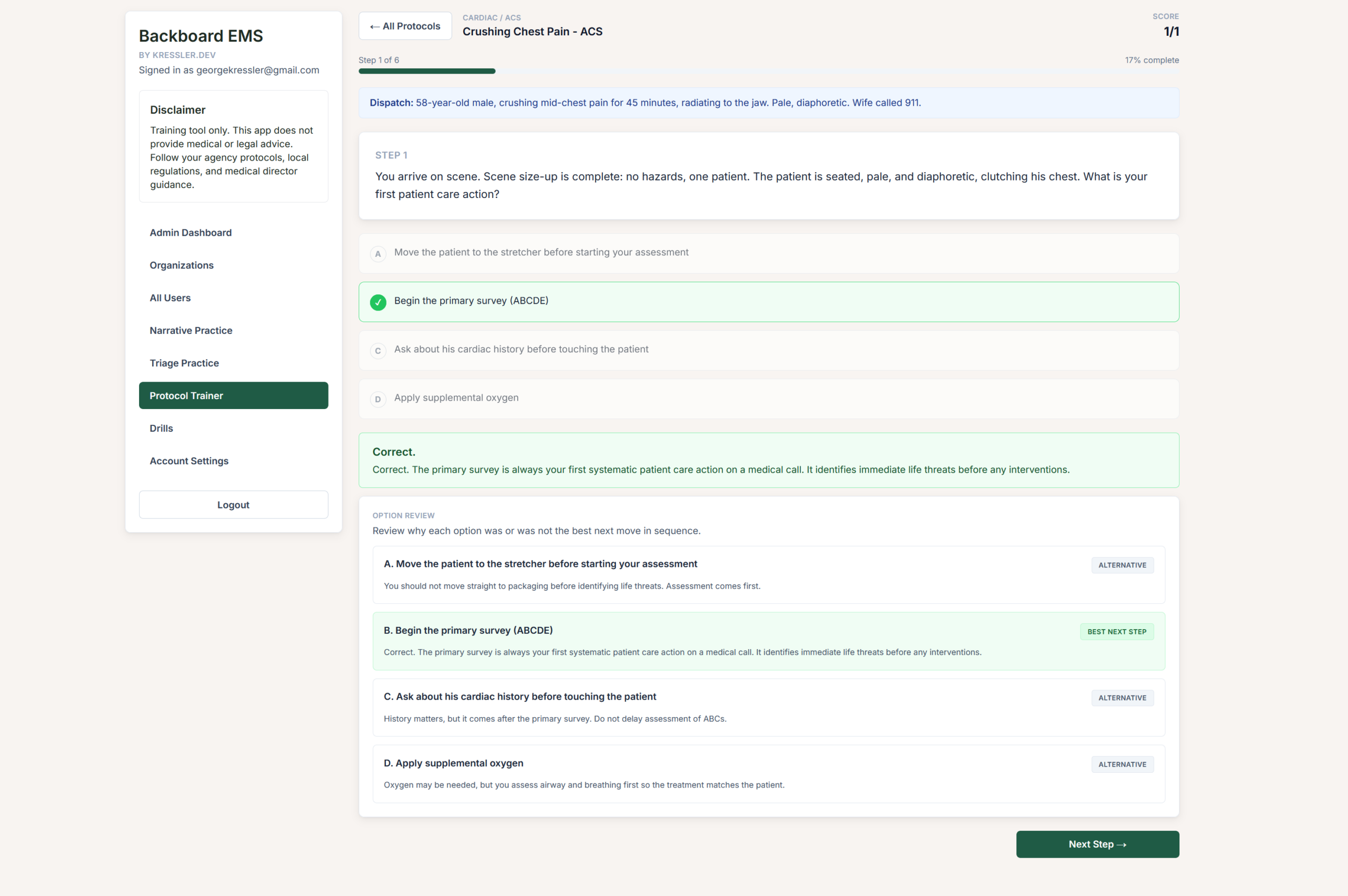
The protocol trainer walks through clinical scenarios as step-by-step decision trees. Pick the right next action, explain why, move to the next step. Eight BLS protocols right now. You see how you did, step by step, with feedback on where you diverged from the correct path.This feature in the app is still under active development, and will continue to expand.
Triage Practice
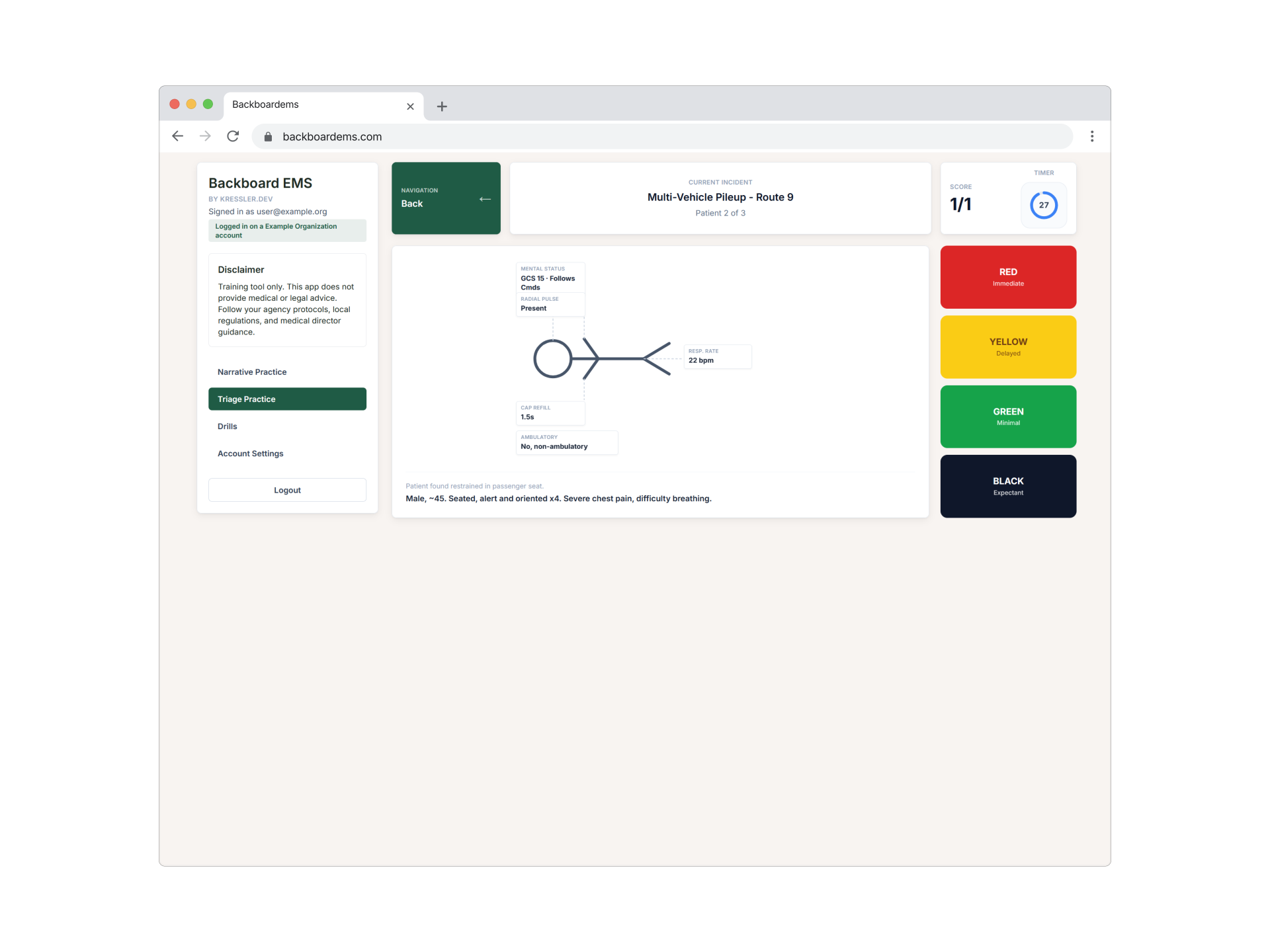
This one is different from the rest of the app. It's gamified. You get a mass casualty scenario like a bus collision or a building collapse, and a timer. Thirty seconds per patient. Tag them with a START triage code. Move to the next one. When you're done, you see your accuracy and exactly which patients you mis-tagged and why. It's intentionally fast and a little stressful because the skill it's training is also fast and a little stressful.
The Team Drill Feature
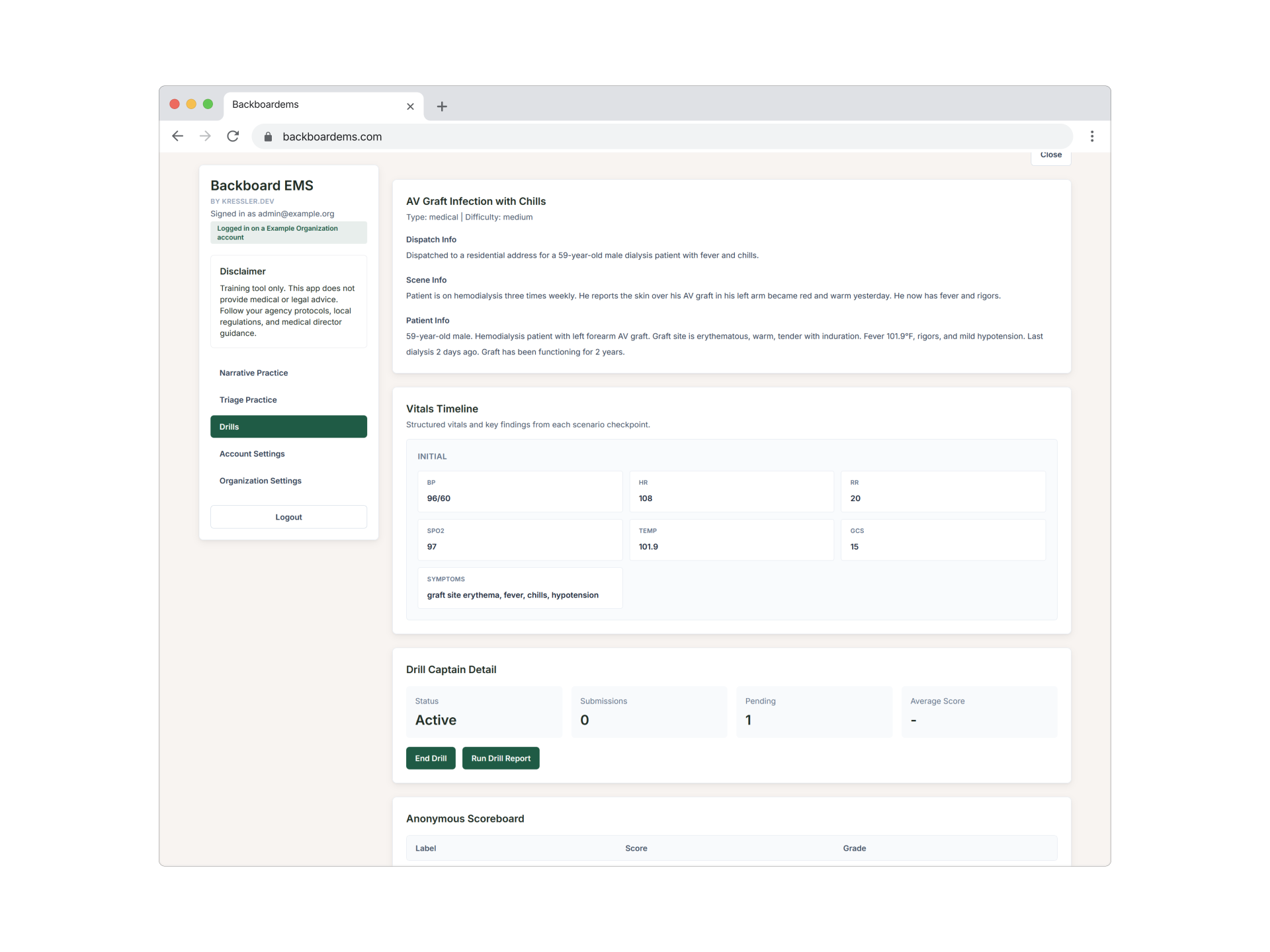
Drills let an org admin (your captain, your training officer, whoever) pick a scenario and open it as a team assignment. Every squad member submits their own narrative for the same call. When the drill is closed, the system generates a group report: average scores across categories, the most common missing elements across all submissions, what the team did well, and specific training recommendations.
Instead of one person reading ten narratives and trying to hold all of it in their head, you get a summary that says: seven out of ten people didn't document vital sign trends in context. That's your training focus for next month/week.
Triage drills work the same way, the captain can see which patients your team consistently mis-tags, and that tells you where to spend some time.
Built for Individuals as well as organizations
I built this to be deployable across multiple squads, not just mine. So there's a full multi-tenant architecture underneath, organizations, roles, and seat counts.
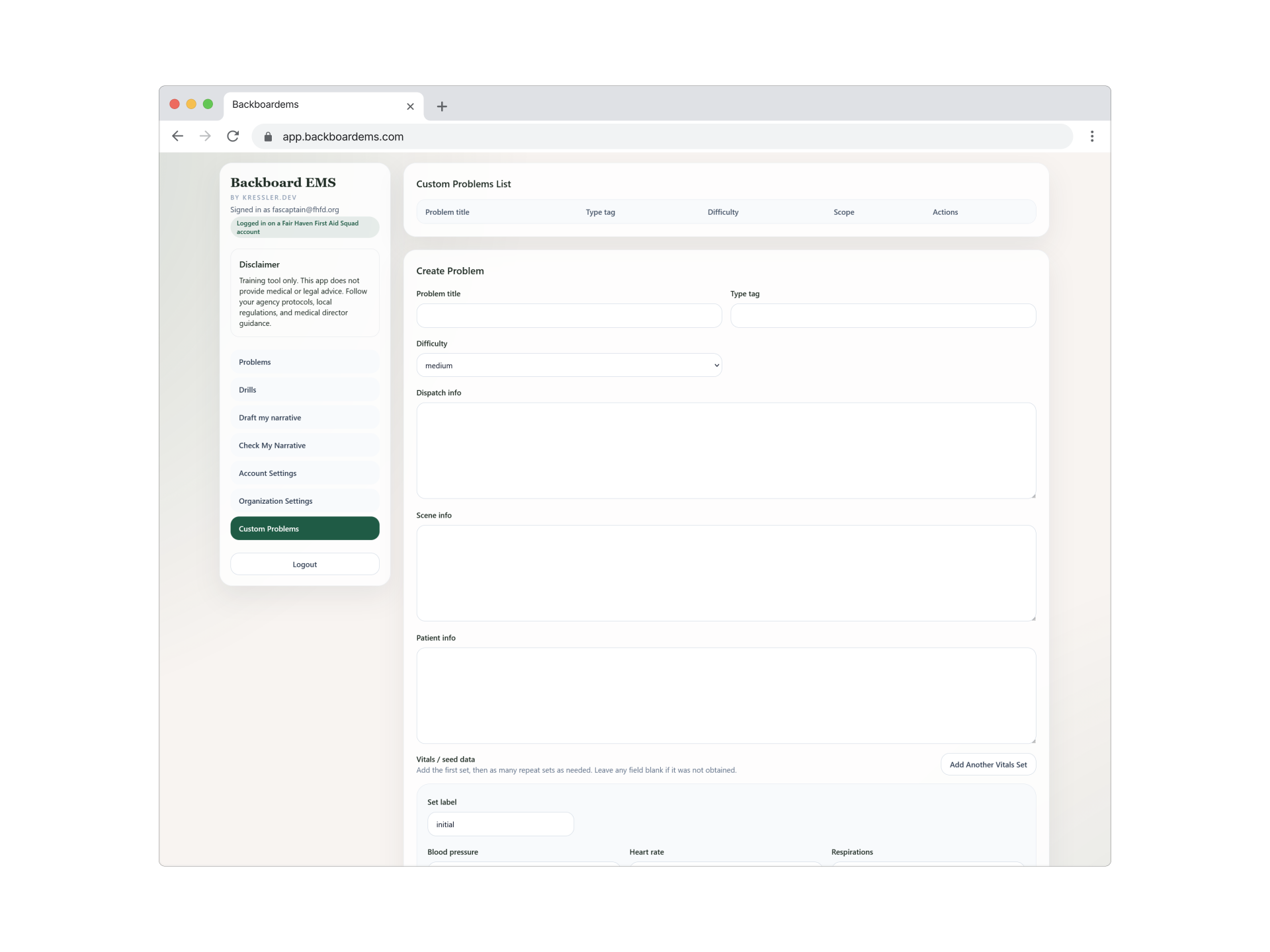
Org admins can customize the evaluation prompts for their region and agency. If you're in NJ and follow the NJ BLS protocols, you can configure the AI to evaluate against those specific standards. You can add notes like "all narratives must include the crew certification number" and the rubric accounts for it.
The subscription system is real, there's a free tier for people kicking the tires, paid plans for teams, all payments are handled through Stripe.
Your organization can also easily connect their Google SSO to the platform for easy account creation, and login management.
Where It's At
The app is live, squads can sign up, org admins can configure their agency settings, and providers can start practicing. The scenario library is solid. Drills work. The feedback is good.
There's more to build, I want to expand the protocol library, add more triage incidents, and keep improving the evaluation prompts. But the core loop works, and it works because it was built to solve a specific real problem that my squad had.
If you run a squad and you're frustrated with documentation quality, I'd genuinely love to hear from you. This is made for you, the EMS provider.